
Scientists as Spies: Cold War FBI Memos Document Exploiting U.S. Residents for Intelligence Purposes

FBI records were obtained from the National Archives on the International Astronomical Union, a nongovernmental organization founded in Belgium that went on to periodically assemble worldwide leaders in astronomy. The 162 pages of records were compiled by the FBI from 1951-1970 and show the complexity of the intersection between academia and the intelligence community. FBI memos included in the records obtained by Expanding Frontiers Research document how international conferences and collaborations serve as opportunities to establish relationships with assets, gather intelligence, and monitor adversaries.
Dr. Frank D. Drake was known to the scientific community for the Drake Equation, a formula that estimated the number of active extraterrestrial civilizations in the galaxy. He was known to the FBI as a confidential informant, numbering among scientists tapped due to their involvement with the International Astronomical Union (IAU). The IAU assembled expert attendees from around the globe to meet in nations including Italy, Ireland and Russia. FBI investigated the likelihood American academics were targeted by foreign adversaries for extraction of classified and sensitive information.
Drake indicated “he would be happy to be of service to the U.S. Government or to the FBI,” and provided the Bureau a directory of the 1958 IAU assembly in Moscow, according to a 1959 FBI memo. He advised FBI how the chairman of the National Radio Astronomy Observatory was in a position to obtain voluminous information from various electronic firms, which represented a potential security risk of classified material. Several pages of the records received pertain to FBI interviews conducted with Drake. From the 1959 memo:

The FBI records were obtained as the result of a FOIA request for material responsive to Peter A. Sturrock, initially submitted to the FBI in June 2025. Sturrock was a British-born Stanford physicist, known for his open-minded approach to unconventional scientific topics. He founded the Society for Scientific Exploration in 1982.
FBI subsequently informed EFR of a file number of potentially responsive records in the custody of the National Archives. EFR then submitted a request to NARA for what turned out to be the file at hand, the subject of which proved to be the International Astronomical Union and containing reference to Sturrock. Additional names of note referenced in the file due to their affiliation with IAU include Harlow Shapley and J. Allen Hynek.
A 1967 memo, subject IAU and depicted below, concerns a then-forthcoming IAU assembly in Prague, Czechoslovakia. Dir. Hoover advised the Washington Field Office to use its sources to develop information about IAU and the scheduled event. The stated objective was to determine whether IAU conferences were being used as recruiting grounds and if U.S. residents were targets. It was noted that FBI interest included exploiting the attendance of U.S. residents for intelligence purposes.
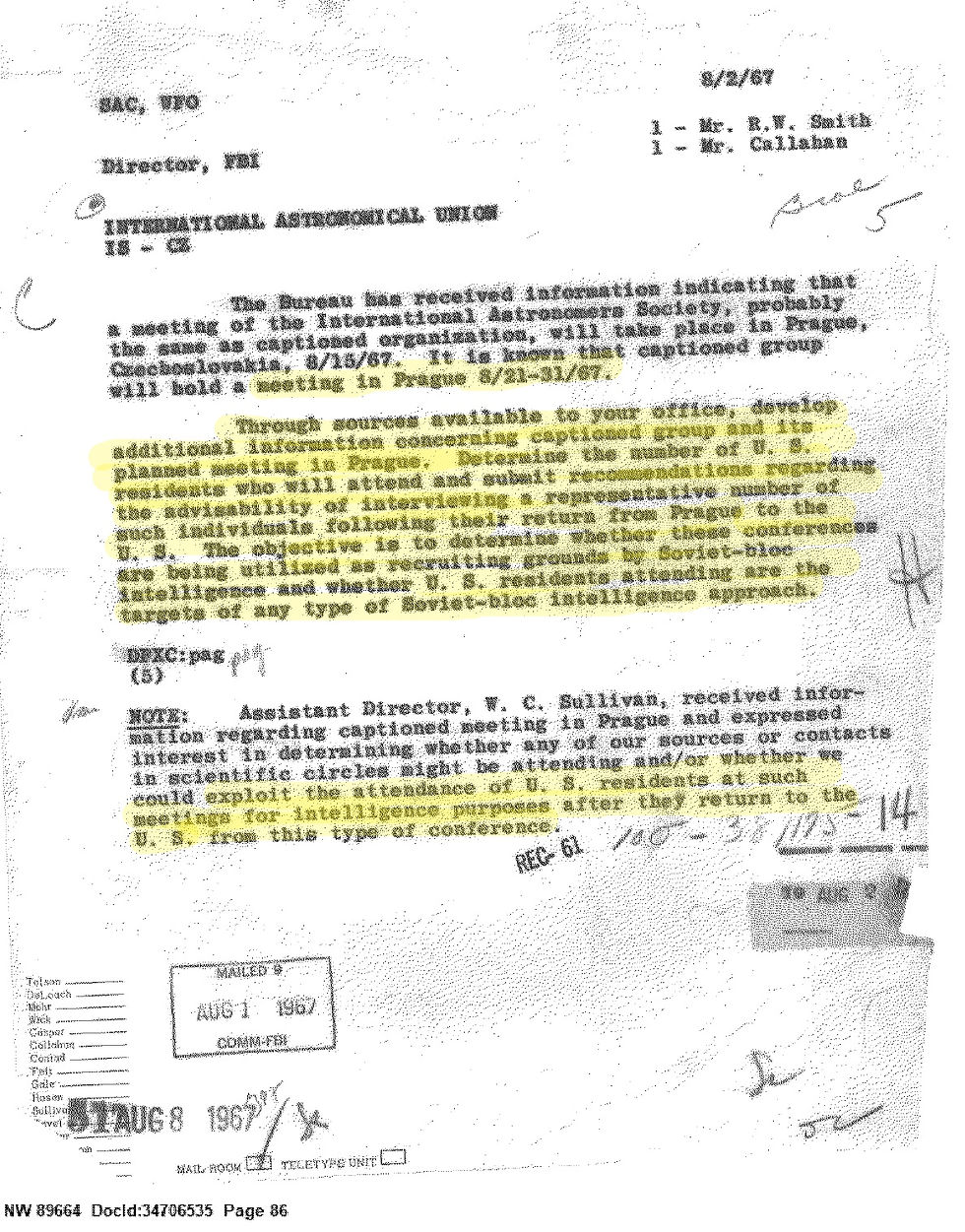
Page one of the memo above is followed by six fully withheld pages. A list then begins on page 93 of the pdf of dozens of what are termed U.S. candidates recommended for admission to the 1967 IAU conference. The list of recommended candidates includes Peter Sturrock. It is not immediately clear why the first name of Sturrock and some of the candidates are penciled in while others are not:

Following the list of recommendations is a list of assembly invitees and a travel flight list, neither of which reference Sturrock. He is then named on a list of awardees of travel grants to the “XIIIth General Assembly of the International Astronomical Union, Prague, Czechoslovakia, 1967.” Over 100 academic travel grant awardees from American institutions are detailed, beginning on page 117 of the 162-page pdf.
The two previously described lists were alphabetized, while the list of travel grant awardees was not; each awardee was numbered, with Sturrock being number 88. The names of IAU attendees from foreign universities and facilities were also monitored on different lists contained in the pdf.
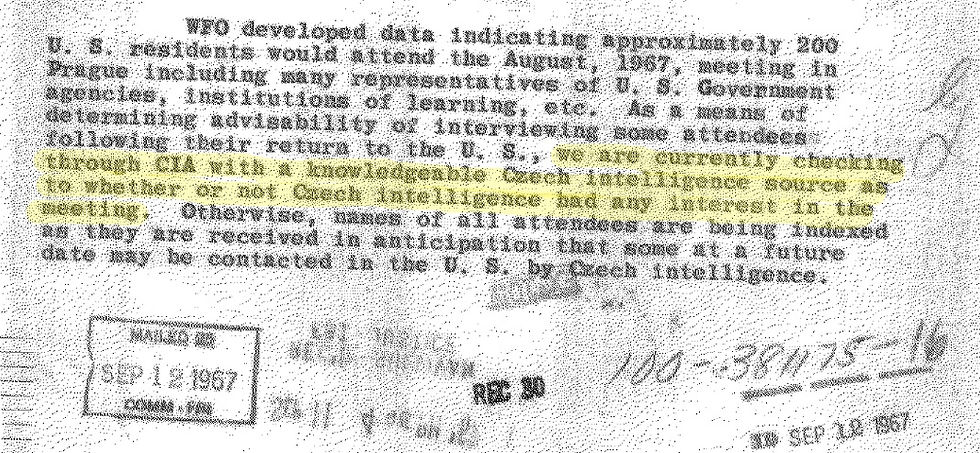
From a September 1967 FBI memo:
Investigations conducted by FBI in 1955 document events surrounding an IAU assembly in Dublin, Ireland. Informants advised the Bureau they previously attended an IAU event in Rome, at which time they met attendees representing the Soviet Union. The informants anticipated seeing some of the same Russians again in Ireland.
The FBI sources further explained their plans to go to Iceland following the completion of the IAU meeting in Ireland. A 1955 Bureau memo documented their plans to speak with the U.S. Air Force about a business venture involving what was termed a “position finder”:


The records are reminiscent of events described in FBI memos previously obtained on the late astronomer Dr. Donald Menzel, employed at Harvard and the subject of hundreds of pages of FBI records. He was documented by the FBI in 1946 as having conducted research for the Navy during World War II. This included experiments that had to do with the ionization of the stratosphere which reportedly helped operators of communications equipment and radar forecast the best hours of each day for use of the equipment. His long academic career was characterized by such classified research, frequent attendance at international conferences, and strong skepticism of unsubstantiated UFO stories, about which he corresponded with Adm. Roscoe Hillenkoetter.
FBI memos composed on Menzel in 1974-75 document his activities, including a 1954 invitation he was extended along with colleagues to observe an eclipse of the sun in the Soviet Union, of which he expressed a lack of interest. FBI noted he was a visitor in 1958 to the 10th General Assembly of the International Astronomical Union conducted in Moscow.
Memos from the 1970s document how consideration was given to contacting Menzel as a “potential security informant or double agent,” as pictured below:

FBI indicated its interest was due in part to Menzel's plans to accept the first personal invitation ever extended from the People's Republic of China to an astronomer. He and his wife subsequently traveled to Peking, where he lectured on astronomy at the Academy of Sciences. During the visit, political complications arose due to his affiliation with none other than the International Astronomical Union because Taiwan was a member and China was thereby reluctant to cooperate. FBI seemingly viewed Menzel as a potentially valuable asset due to his connections and frequent travel.
During FBI considerations to formally recruit Menzel, the astronomer apparently communicated he was “more than willing” to discuss Bureau internal security responsibilities but, by the way, he was already talking to the CIA:

EFR contends that obtaining and reviewing such records not only helps in filling in historical context often absent from unsubstantiated speculation but also provides insight into more recent events. The overlap of academia, politics, and the intelligence community has a lot of moving parts that should be carefully considered with nuance and objectivity when forming assessments.


It's great how writing on niche but important topics can elicit resources from the grass-roots.
"The overlap of academia, politics, and the intelligence community has a lot of moving parts that should be carefully considered with nuance and objectivity when forming assessments. "
This is more relevant today than ever. I will make sure that a larger audience reads this.